
Quantum computing is no longer a futuristic concept reserved for physicists and research labs. With global tech leaders investing heavily in quantum technologies, learning Quantum Computing Foundations has become a smart move for beginners who want to future-proof their careers. But for many newcomers, the topic feels complex and intimidating.
This blog simplifies quantum computing concepts and provides a clear learning path for beginners, helping you understand what quantum computing is, why it matters, and how you can start learning it step by step.
What Is Quantum Computing?
Quantum computing is a new computing paradigm that leverages the principles of quantum mechanics to process information. Unlike classical computers that use bits (0 or 1), quantum computers use qubits, which can exist in multiple states simultaneously.
This ability allows quantum computers to solve certain problems exponentially faster than classical computers—especially in areas like optimization, cryptography, drug discovery, and complex simulations.
Why Quantum Computing Matters Today
Quantum computing is gaining momentum due to its potential to transform industries and solve problems that are currently impractical or impossible for classical systems.
Key reasons why quantum computing matters:
- Rapid growth in research and enterprise adoption
- Strong investments from companies like IBM, Google, Microsoft, and Amazon
- Breakthroughs in AI, cybersecurity, and scientific research
- Growing demand for quantum-skilled professionals
For beginners, learning the foundations now provides a long-term advantage as the technology matures.
Market Trends: The Quantum Computing Boom
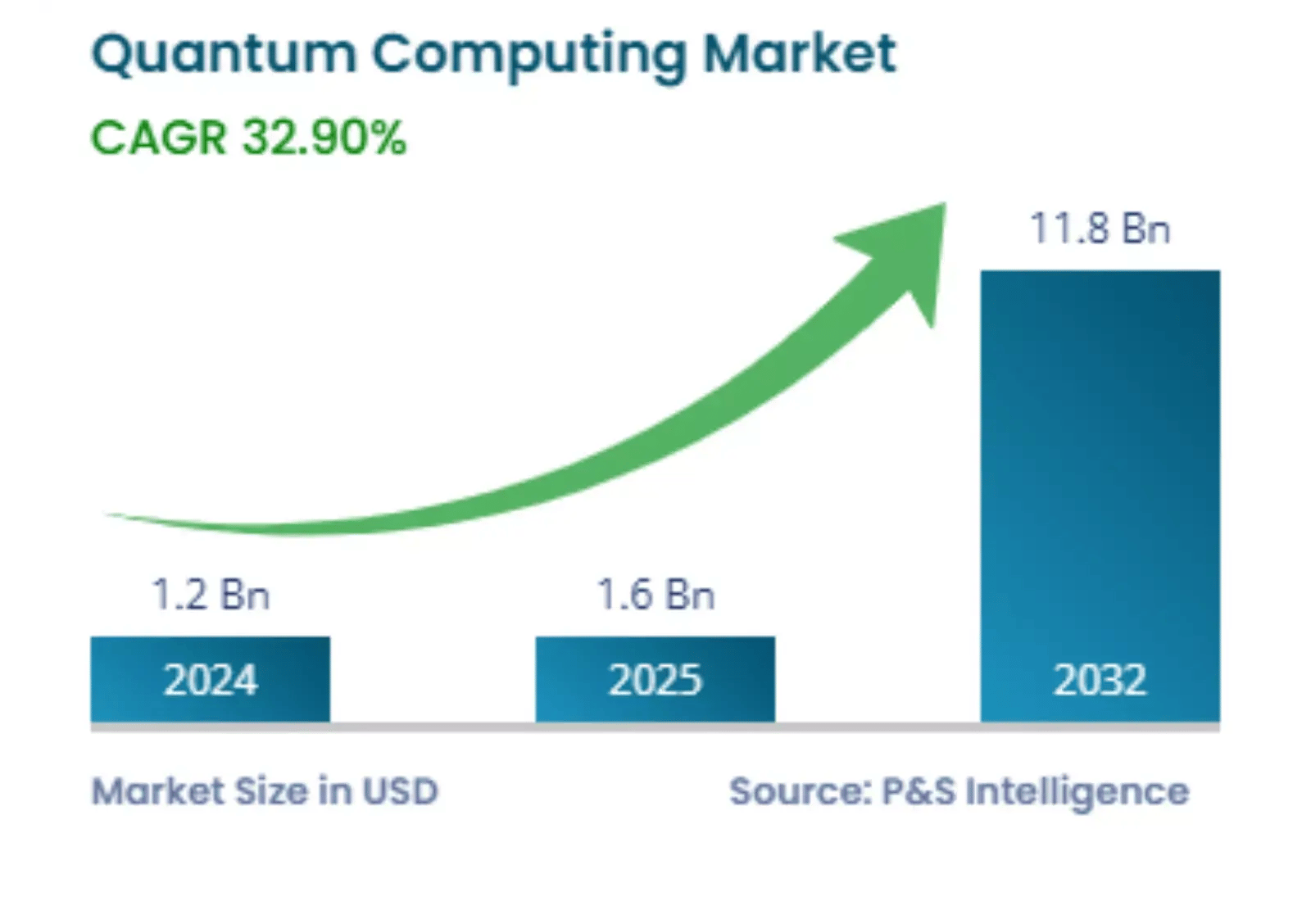
To understand why learners and professionals are excited about quantum computing, let’s look at the latest market data and growth forecasts.
Global Market Growth Forecasts
Here’s what analysts are projecting for the quantum computing market:
- The quantum computing market is estimated at about USD 1.44 billion in 2025 and is projected to grow rapidly over the next decade.
- Some reports forecast it could reach USD ~$7.3 billion by 2030 with a ~35% CAGR through the decade.
- Other estimates suggest even faster growth, with the market hitting over USD 16+ billion by the early 2030s.
- Long-term industry analyses from strategy firms like McKinsey suggest the broader quantum tech ecosystem (computing + sensing + communication) might be worth tens of billions by 2035–2040.
Key takeaway: Across multiple reports, the quantum computing market is consistently shown as a high-growth sector, offering expanding career and research opportunities.
Breakdown of Growth Drivers
Here’s why the market is growing so fast:
- Cloud Quantum Services: More companies are accessing quantum systems through cloud platforms instead of owning hardware. Mordor Intelligence
- AI & Machine Learning Integration: Quantum tech is expected to enhance next-generation workflows in AI. Business Wire
- Industry Adoption: From financial services to healthcare to logistics optimization, enterprises are exploring quantum computing pilots. Global Growth Insights
- Government Investment: National initiatives worldwide are boosting funding and infrastructure for R&D.
Classical Computing vs Quantum Computing
Understanding the difference between classical and quantum computing helps beginners grasp why quantum computing is revolutionary.
| Aspect | Classical Computing | Quantum Computing |
|---|---|---|
| Data Unit | Bit (0 or 1) | Qubit (0, 1, or both) |
| Processing | Sequential | Parallel through superposition |
| Problem Solving | Limited scalability | Exponential speedup for specific tasks |
| Applications | General-purpose | Optimization, simulation, cryptography |
Core Concepts in Quantum Computing Foundations
1. Qubits
A qubit is the fundamental unit of quantum information. Unlike classical bits, qubits can represent multiple values at once.
2. Superposition
Superposition allows qubits to exist in multiple states simultaneously, enabling massive parallel computation.
3. Entanglement
Entanglement links qubits together so that the state of one qubit directly affects another, even over long distances.
4. Quantum Gates
Quantum gates manipulate qubits and form quantum circuits, similar to logic gates in classical computing.
5. Measurement
When qubits are measured, their quantum state collapses into a definite value, producing the final output.
How Quantum Computing Works (Beginner View)
At a high level, quantum computing follows these steps:
- Initialize qubits
- Apply quantum gates to create superposition and entanglement
- Run the quantum circuit
- Measure the qubits to get classical results
This process enables quantum systems to explore many possible solutions simultaneously.
Applications of Quantum Computing
Quantum computing has real-world applications across industries:
- Cryptography: Breaking and designing secure encryption algorithms
- Healthcare: Drug discovery and molecular simulation
- Finance: Risk analysis and portfolio optimization
- Artificial Intelligence: Speeding up machine learning models
- Supply Chain: Optimizing logistics and routing problems
Who Should Learn Quantum Computing Foundations?
Quantum computing foundations are suitable for:
- Students and fresh graduates
- Software developers and engineers
- Data scientists and AI professionals
- Researchers and academics
- Technology leaders and decision-makers
No advanced physics degree is required to start—most beginner courses focus on conceptual understanding and practical exposure.
Skills Required to Start Learning Quantum Computing
Beginners should focus on building the following skills:
- Basic mathematics (linear algebra concepts)
- Programming fundamentals (Python preferred)
- Logical thinking and problem-solving
- Curiosity about emerging technologies
Many beginner programs teach these skills alongside quantum concepts.
Learning Path for Beginners in Quantum Computing
Here is a clear roadmap for beginners:
-
Understand Quantum Basics
-
Qubits, superposition, entanglement
-
-
Learn Quantum Math Concepts
-
Vectors, matrices, probability
-
-
Explore Quantum Programming
-
Python with quantum frameworks (Qiskit, Cirq)
-
-
Build Simple Quantum Circuits
-
Hands-on simulations
-
-
Study Real-World Use Cases
-
Industry applications and case studies
-
Following this structured approach makes learning manageable and effective.
Career Opportunities in Quantum Computing
As quantum technology evolves, career opportunities are expanding rapidly.
Popular roles include:
- Quantum Software Developer
- Quantum Research Analyst
- Quantum Algorithm Engineer
- Quantum Data Scientist
- Quantum Computing Consultant
Early learners gain a significant advantage as demand outpaces supply.
Why Start Learning Quantum Computing Now?
- Early adoption advantage
- High future salary potential
- Cross-industry relevance
- Strong alignment with AI and advanced computing
- Growing global demand for quantum talent
Starting with foundations ensures you build confidence before moving into advanced topics.
Conclusion
Quantum computing is shaping the future of technology, and learning its foundations doesn’t have to be overwhelming. With the right guidance and a structured learning path, beginners can confidently enter this exciting domain.
Learning Quantum Computing Foundations today sets you on a clear, future-ready path—opening doors to innovation, research, and high-impact careers tomorrow.

What Is Adobe Workfront Fusion? A Simple Guide for Complete Beginners

Why Adobe Launch is a Game-Changer for Modern Marketers

No Comments Yet
Let us know what you think