
What is SAP Cloud ALM?
SAP Cloud ALM (Application Lifecycle Management) is SAP’s cloud-native ALM offering that helps organizations implement, operate, monitor, and manage SAP cloud solutions and hybrid landscapes. It’s a SaaS platform managed by SAP that provides tools for project delivery (Activate-ready processes), test and deployment support, process monitoring, alerts and operations dashboards — all with the aim of reducing on-prem maintenance and increasing transparency across SAP landscapes.
Market share & industry outlook (with graphs)
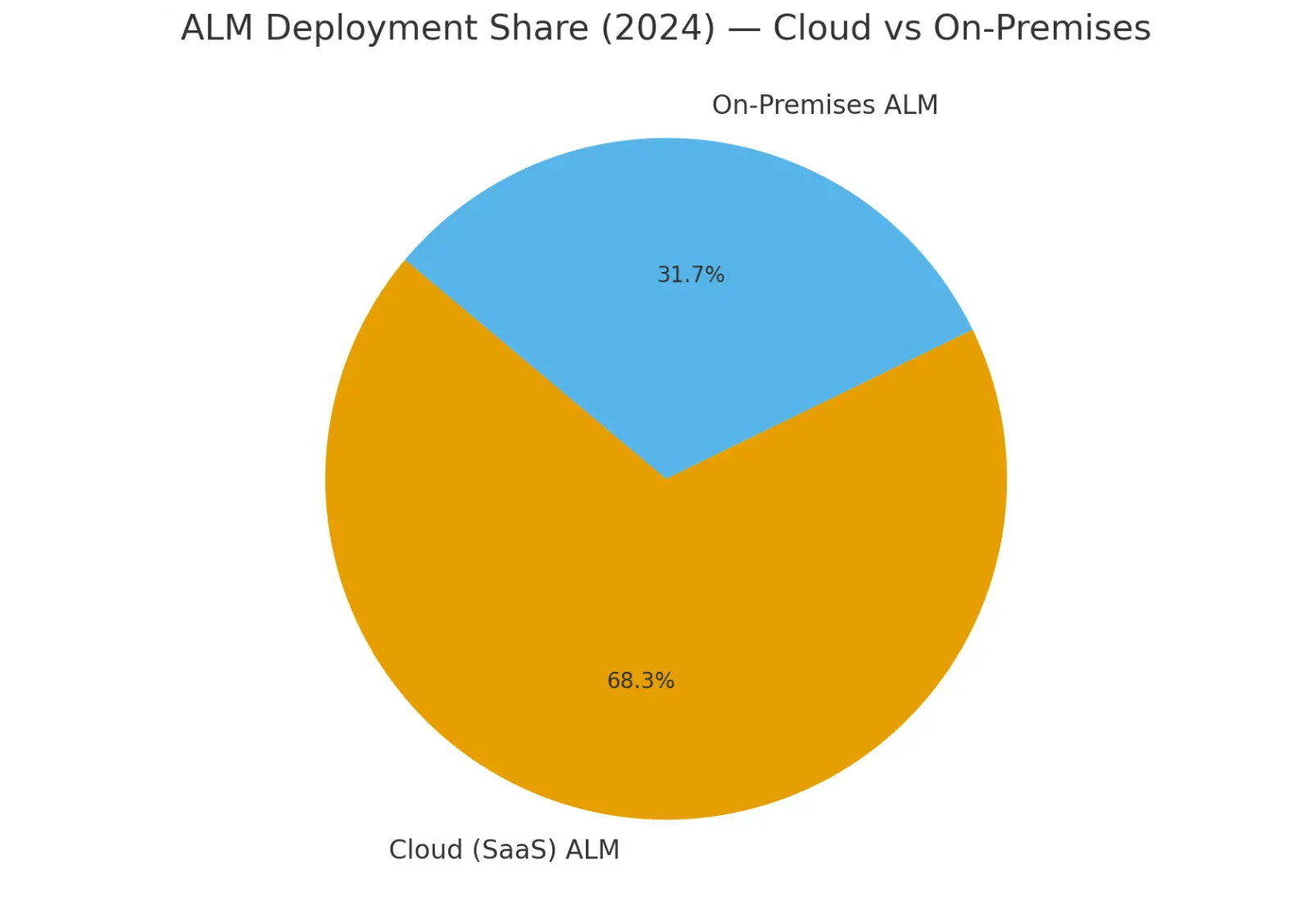
Snapshot: The broader Application Lifecycle Management market is growing, and cloud/SaaS ALM solutions hold a large and growing portion of that market. Industry research shows a dominant cloud (SaaS) share of ALM deployments (cloud ~68% in 2024) and multi-year growth forecasts for the ALM market. This is driving demand for cloud-native ALM skills, including SAP Cloud ALM.
Why take SAP Cloud ALM training?
-
Cloud-first industry shift. SAP and its customers are moving toward cloud/SaaS solutions — those who know cloud ALM tools can help run projects and operations more efficiently.
-
High demand in implementation & managed services. Consultancies and in-house SAP teams need people who know Cloud ALM for implementations, migrations (Solution Manager → Cloud ALM), monitoring and operations.
-
Good entry point to SAP cloud careers. Cloud ALM knowledge pairs well with SAP Activate, SAP S/4HANA, SAP BTP, and testing/DevOps practices — making you more employable across delivery and support roles. SAP Support
- Lower initial barrier to entry than deep functional modules. Learning how ALM supports processes, testing, and release management is approachable — technical depth can be added later (integrations, S/4 configuration, scripting).

Who can do SAP Cloud ALM training?
- Beginners with some IT background: graduates in CS/IT or allied degrees, or IT helpdesk/ops staff wanting to move to SAP operations.
- SAP functional consultants (e.g., MM, FI, SD) who want to broaden into project delivery/ALM processes.
- Technical consultants/DevOps engineers aiming to understand SAP delivery pipelines.
- Project managers and release managers who want hands-on knowledge of how SAP delivers and operates cloud solutions.
- Test engineers who will use ALM for test planning and execution.
Course outcome — what you’ll learn
A good SAP Cloud ALM course (or learning path) should give you:
- Core concepts: Cloud ALM architecture, modules (Implementation, Operations, Process Monitoring, Test Management).
- How SAP Cloud ALM integrates with SAP Activate and S/4HANA project lifecycle.
- Hands-on tasks: create projects, configure process content, manage requirements, design test cases, execute tests, and use monitoring dashboards.
- Practical migration knowledge: planning a transition from SAP Solution Manager to Cloud ALM.
- Basic scripting / automation around ALM APIs (optional advanced topic).
- Soft skills: stakeholder reporting, runbook creation, incident/escalation handling.
Career opportunities for SAP Cloud ALM professionals
Common roles that either center on or use SAP Cloud ALM skills:
- SAP Cloud ALM Consultant / Specialist — implement and configure Cloud ALM for customers.
- SAP Implementation / Delivery Consultant — use Cloud ALM during S/4HANA deliveries (project setup, documentation, test management).
- Application Support / Operations Engineer — monitor processes, respond to alerts, maintain runbooks.
- Test Manager / Test Automation Engineer (SAP focus) — manage test cycles, integrate automation results with Cloud ALM.
- Release/Change Manager — coordinate transports, cutovers and release plans using ALM tools.
- Cloud ALM Product Owner / Functional Lead — in larger enterprises/managed services, owning ALM configuration and maturity.
Many of these roles exist in SAP consulting firms, system integrators, product companies that run SAP, and in SAP’s own services.
Salary package — Experience vs Package (USD) (graphical representation included)
Important: salary figures below are estimates and aggregated from public salary sites and market signals for SAP cloud-related consultant roles. Actual pay varies by country, employer, benefits, and individual negotiation. The chart displayed shows an estimated progression:

These ranges are consistent with marketplace salary signals for SAP cloud consultants (for example, Glassdoor and industry salary surveys for SAP cloud roles show median/average figures in the ranges used to build the chart).
Companies that hire SAP Cloud ALM professionals
Typical employers and hiring hubs include:
- Global system integrators & consultancies: Accenture, Deloitte, Capgemini, Cognizant, Infosys, Wipro, TCS — they run large SAP transformation and managed-services projects and often hire ALM consultants.
- Regional SAP partners and boutique SAP consultancies that specialize in S/4HANA migrations.
- End-user enterprises (large manufacturing, retail, pharma and finance firms) with internal SAP teams.
- SAP itself and SAP ecosystem players who deliver Cloud ALM professional services or product integrations.
Tip: look for roles with keywords: “SAP Cloud ALM”, “SAP ALM”, “ALM consultant”, “SAP Solution Manager to Cloud ALM migration”, “SAP Activate / Implementation Consultant”.
Roles and responsibilities (day-to-day)
SAP Cloud ALM Consultant (typical responsibilities)
- Configure Cloud ALM tenant: set up projects, activate content, map business processes.
- Support implementation teams: enable SAP Activate features, track requirements and tasks.
- Create and manage test plans, coordinate test execution and defect tracking.
- Set up monitoring dashboards, configure alerts and KPIs for business processes.
- Provide runbooks and operational support for production incidents/changes.
- Assist in migrations from Solution Manager and integrate ALM with other ITSM/DevOps tools.
- Train stakeholders on ALM usage and best practices.
Operations / Support Role
- Monitor process health, respond to alerts, coordinate with basis/functional teams.
- Maintain documentation, release notes and knowledge base.
- Execute root cause analysis for recurring incidents.
Steps to prepare for SAP Cloud ALM certification and job-readiness
Follow this step-by-step plan — aim for 2–4 months for a motivated beginner (timeline flexible):
-
Understand the fundamentals (1–2 weeks)
-
Learn what ALM means in SAP context: Solution Manager vs Cloud ALM. Read official SAP Cloud ALM documentation.
-
-
Enroll in an introductory course (2–4 weeks)
-
Take SAP Learning or a trusted training provider course such as “Implementing with SAP Cloud ALM” to get hands-on tasks and labs.
-
-
Get hands-on practice (3–6 weeks)
-
Use trial tenants (if available), sandbox systems, or guided labs. Practice creating a project, test plans, and monitoring dashboards.
-
If no tenant is available, follow guided lab exercises and screenshots until you can access a tenant.
-
-
Learn related topics in parallel
-
SAP Activate methodology, basics of S/4HANA solution structure, and a primer on SAP BTP and integration concepts — these make you far more valuable during implementations.
-
-
Work on a mini-project
-
Document a mock implementation: create requirement backlogs, scope items, test cases, and monitoring KPIs in Cloud ALM (even if simulated).
-
-
Prepare for certification / validation
-
SAP’s official course completion certificate / vendor certificates are useful. While SAP’s Cloud ALM-specific formal certification pathways can change, complete SAP Learning courses and collect badges.
-
-
Build a resume & LinkedIn profile
-
Highlight practical tasks: “Configured Cloud ALM project”, “Managed test cycles of X scenarios”, “Created operational dashboards”. Add keywords so recruiters find you.
-
-
Apply to entry-level roles and internships
-
Target consulting firms and internal SAP teams; be open to roles that combine ALM work with testing or basis/support tasks.
-
-
Keep learning & specialize
-
Gain deeper skills in Test Automation (Tosca, Worksoft), SAP BTP, or integration to increase market value.
-
Conclusion
SAP Cloud ALM is an excellent entry point into cloud-native SAP delivery and operations. The ALM market is shifting heavily toward cloud/SaaS, and professionals who understand how to run implementations, tests, and operations using Cloud ALM will be in demand across consultancies and enterprise SAP teams. Start with official SAP Learning courses, get hands-on practice, pair your ALM skills with S/4HANA or testing expertise, and you’ll be positioned for solid career growth — both in responsibility and compensation.

Master SAP Analytics Cloud: Skills Every Analyst Needs in 2025

Launch Your Career in SAP Security with Cloud IAG Skills

No Comments Yet
Let us know what you think